Buying or building industrial space in Magnolia? Here is how city and county drainage review, detention rules and pond upkeep shape usable acreage.
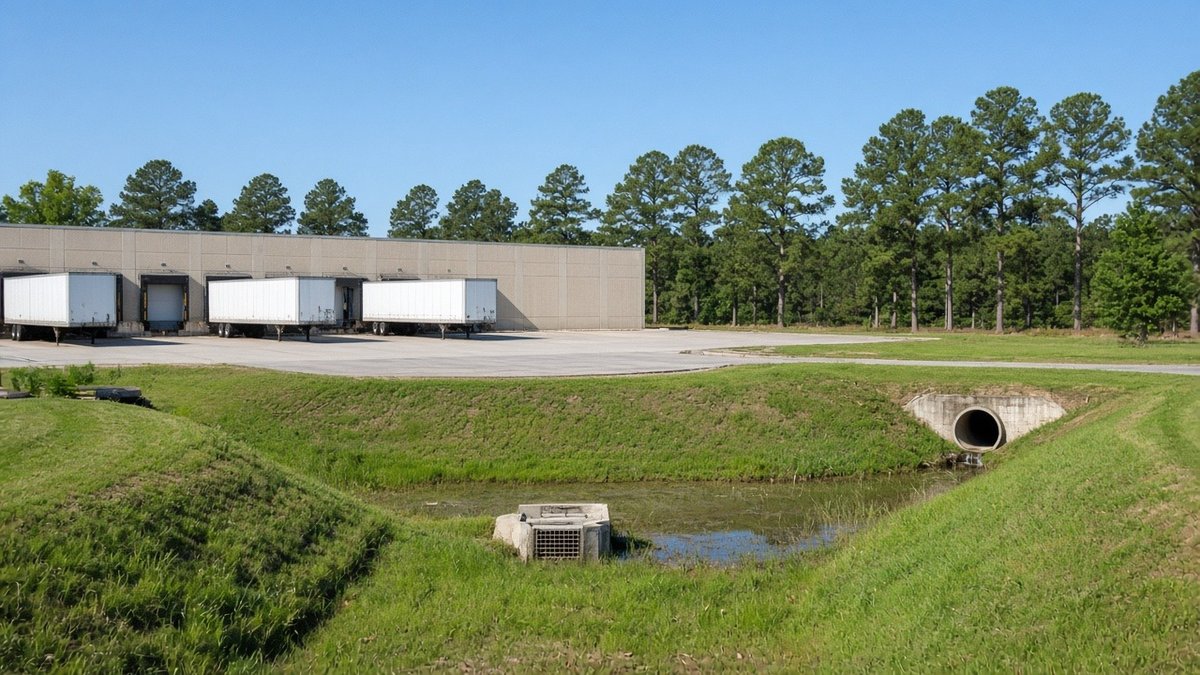
On a Magnolia industrial deal, the detention pond is often the line item that decides how much building and truck court the land can really hold. A buyer sees ten acres on the survey, but after drainage review the usable pad can look very different.
City or county: where the site sits sets the reviewer
Magnolia is an incorporated city in Montgomery County, and much of the land around it sits in the city's extraterritorial jurisdiction or in unincorporated county. Inside the city limits, the Unified Development Code says the City Engineer must review and approve the drainage report and plans before any building permit is authorized, and that the City Engineer has final authority on engineering interpretations. The city's engineering page states that Magnolia uses the Montgomery County Drainage Criteria Manual, and it says its standard construction details apply in both the city and the ETJ.
Outside the city, the Montgomery County Engineer and the county Drainage Criteria Manual govern. The county adopted an updated manual in 2025 and approved amendments in September 2026, so ask your engineer which version your submittal will be reviewed under. Near the line, we confirm jurisdiction first.
The no adverse impact standard
The county manual is built around no adverse impact, the principle that one owner's project should not harm neighbors. For drainage approval, it says the project may not increase the peak flow leaving the site compared with pre-project conditions, and it also looks at water surface elevations, velocity and the type of flow. If water leaves your tract as sheet flow today, the manual says it must remain sheet flow after development. The assessment is made everywhere water enters and leaves the property.
Magnolia adds its own layer. The city's code and engineering page say drainage systems must include retention or detention that provides a 10 percent reduction in runoff from pre-construction conditions, and a lower reduction needs written approval from the City Engineer. That means a city site may need more storage than a matching county site, so ask the city engineer early how that reduction is applied to your parcel.
The drainage report and who signs it
The UDC requires a drainage report and plans prepared by a registered engineer for land that is subdivided, developed or improved for commercial use. Magnolia's construction standards say plans, specifications and studies must be prepared under a professional engineer licensed in Texas and carry the engineer's seal. The city's storm drainage standards also call for detention pond analysis with supporting model files and a pilot channel so the pond drains fully. We leave sizing to the civil engineer. Storage volume depends on impervious cover, soils, the outfall and the release rate the reviewer accepts, so treat any rule of thumb from a neighboring deal as a guess.
Outfall and the receiving channel
A pond is only as good as its outfall. Ask early where the site drains: a roadside ditch, a storm sewer, a natural channel or a neighbor's tract. The county manual addresses detention outfalls separately and requires maintenance access along improved channels. Where a pond has a berm or dam, the manual flags that it can fall under state dam safety rules. Flood zones belong in the same diligence file, and our Jersey Village floodplain permit guide covers that side, but drainage review applies even when a site is outside the mapped floodplain.
Who maintains the pond after closing
The county manual states that Montgomery County does not maintain storm sewer systems or detention facilities, and the construction plans must name the party responsible for maintaining them. On a private industrial site, that is usually the owner. For a buyer, that means mowing, silt removal, outlet repair and erosion control become operating costs, and on a multi-tenant park, the lease or declaration should say who pays.
How detention eats industrial acreage
Warehouse and yard users need flat, paved area. Truck courts, trailer parking and outdoor storage add impervious cover, and more pavement usually means more storage. A pond, its side slopes, freeboard and maintenance access all come out of the same tract, so the building, the court depth and the yard may shrink. When we compare industrial and warehouse property, we value net usable acres, not gross acres.
Plat and site plan sequencing
In the city, plats and site plans are submitted through the city's online portal, and the engineering page offers a pre-development meeting and posts a submittal calendar for Planning and Zoning and City Council. The drainage plan must be approved before a building permit, so a contract with a short feasibility period can run out before the engineer has an answer. We like to schedule the pre-development meeting before the option period starts.
Questions we bring to the city or county engineer
- Is the site inside Magnolia's city limits, in the ETJ or in unincorporated county, and which office reviews drainage?
- How will the city's runoff reduction apply to this tract, and will a lower percentage be considered?
- Which version of the county manual governs our submittal?
- Where is the accepted outfall, and does the receiving ditch or channel have capacity?
- Is shared, regional or underground detention an option here?
- Who will maintain the pond, and what must the plans and any agreement show?
- What are the current submittal deadlines, fees and review steps?
This is general information, so confirm current requirements with the City of Magnolia engineering department, the Montgomery County Engineer and your civil engineer before you commit.
How we help
Our tenant representation team builds drainage and detention questions into site selection for users who need yard and dock space. If you are weighing industrial land or a building around Magnolia, talk with our team before you lock in a site plan.