Buying, building or expanding industrial space in Jersey Village? Here is how the city's floodplain development permit review works and what to ask early.
For industrial users in Jersey Village, the big question is where a site sits relative to the floodplain. The city lies in the White Oak Bayou watershed, and the Harris County Flood Control District built the Jersey Village Bypass Channel to carry part of White Oak Bayou's flow around the city during heavy rain. If you are buying, building or expanding warehouse or flex space here, floodplain development permit review is one of the first items we put on the calendar.
When a floodplain development permit applies
In Chapter 14, Article IX of the city code, Section 14-225 requires a floodplain development permit before anyone locates, alters or changes the use of a structure or land within an area of special flood hazard. Additions and site work can count, not just new buildings. The city's permit FAQ also says properties in a special flood hazard area go through a development review in addition to the normal permit process.
The city adopts FEMA's Flood Insurance Study for Harris County and the Flood Insurance Rate Maps dated November 15, 2019, plus any revisions. So our first step is pulling the effective FIRM panel for the parcel from FEMA's Map Service Center or the National Flood Hazard Layer, then asking the city how it reads the boundary.
Who reviews it and what goes in the file
The code names the director of public works, or a designated agent, as floodplain administrator. That office reviews, approves or denies floodplain development permits and interprets where the flood hazard boundary falls when the map and field conditions disagree. For an industrial project, expect the application to include:
- Scaled site plans showing existing and proposed structures and their location relative to the special flood hazard area.
- The lowest floor elevation of new or substantially improved buildings, tied to sea level datum.
- The floodproofing elevation for any nonresidential building that will be floodproofed rather than elevated, with a certificate from a Texas registered engineer or architect.
- A description of any change to a watercourse or natural drainage caused by the project.
The administrator weighs factors including danger to life and property, how susceptible the facility and its contents are to damage, whether materials could be swept onto other land, and emergency vehicle access during a flood. For inventory-heavy warehouses or outdoor storage, raise those early.
Elevate or floodproof: the nonresidential choice
Commercial and industrial buildings get two paths. The lowest floor can be elevated to meet the city's Table 14-5 minimum flood protection elevations, or the building, along with its utility and sanitary facilities, machinery and equipment, can be dry floodproofed so it is watertight below the base flood level and able to resist water pressure and buoyancy. A floodproofed design must be certified by a Texas registered engineer or architect, and the code calls for FEMA's Floodproofing Certificate for Non-Residential Structures.
Table 14-5 measures freeboard from the 0.2 percent annual chance (500-year) flood elevation, not just the base flood, and the amount varies by zone. Ask the floodplain administrator which row applies to your building and foundation type, and have your engineer run the numbers before you price a pad. FEMA's insurance rating credit for dry floodproofing can call for a higher elevation than the minimum permit standard, so loop in your insurance agent.
Fill, detention and grading
This is where industrial budgets move. For nonresidential construction in special flood hazard areas, the code says no additional fill is allowed below the 500-year floodplain elevation, and cut and fill quantities must be shown on the plans. If your plan assumes imported fill for a building pad, check with the city first.
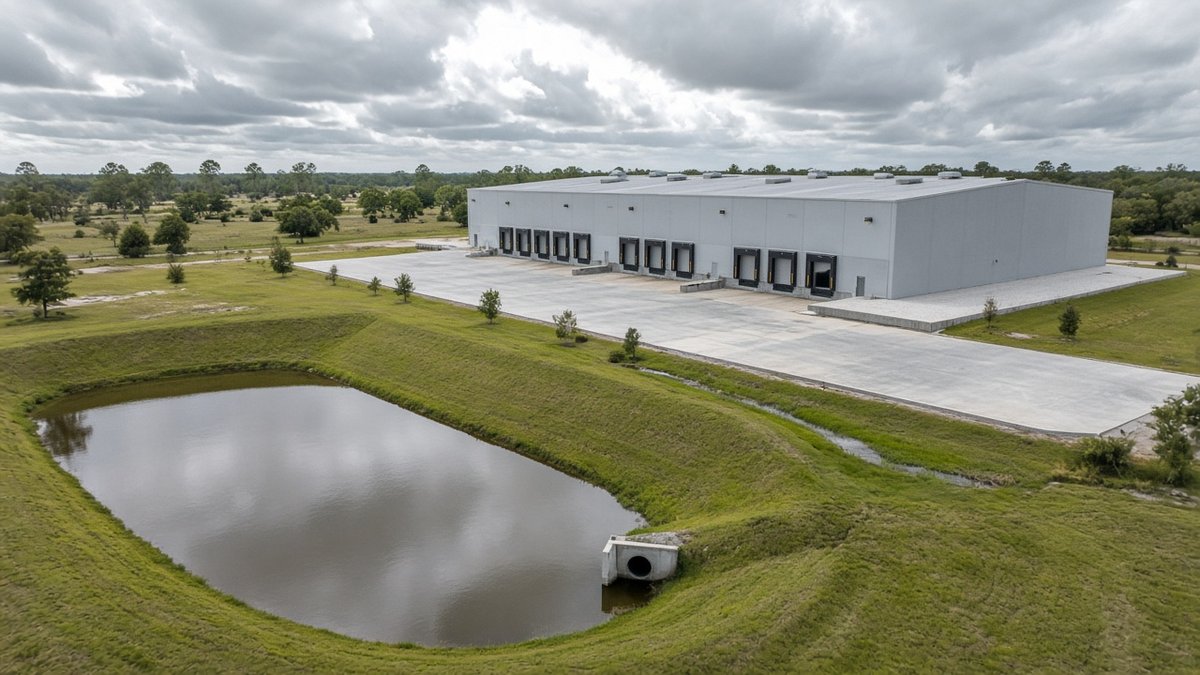
Separately, Section 14-226 requires stormwater detention for any nonresidential development, whether or not it sits in a mapped floodplain. Detention eats land that could hold building area, truck courts or trailer parking, so size it in your early yield math. The city also requires a permit before grading or any work within a watercourse, and channel design and discharge points need Harris County Flood Control District approval.
Existing buildings and map changes
Buyers of older buildings should study the substantial improvement rule. The code uses a test of 50 percent of the structure's market value: when improvement costs reach that level, the existing building must meet the standards for new development. Ask how the city applies that test to your building and calculates value and cost.
Some parcels may qualify for a FEMA Letter of Map Amendment if natural ground sits above the base flood elevation, or a Letter of Map Revision based on Fill. Projects that would change flood elevations or boundaries may need a Conditional Letter of Map Revision before construction and a Letter of Map Revision after. These take engineering and time, so start them in due diligence.
Questions we bring to the city early
- Which FIRM zone and Table 14-5 row apply to this parcel and building type?
- Does the proposed change of use, addition or site work trigger a floodplain development permit?
- Will the city accept dry floodproofing for this design, and what elevation must the certificate show?
- How will detention and the no-fill rule affect usable building area?
- Are any Harris County Flood Control District approvals needed for the outfall?
This is general information, so confirm requirements with the city's floodplain administrator and your own engineer before you commit.
How we help
When we evaluate industrial and warehouse property in northwest Harris County, flood review sits next to zoning, utilities and access on our checklist. For occupiers, our tenant representation team builds these questions into site tours and lease negotiations so flood issues surface before you sign. For buyers and sellers, our investment advisory work accounts for detention, fill limits and floodproofing costs in pricing. If you are weighing an industrial site or expansion in Jersey Village, talk with our team before you lock in a plan.