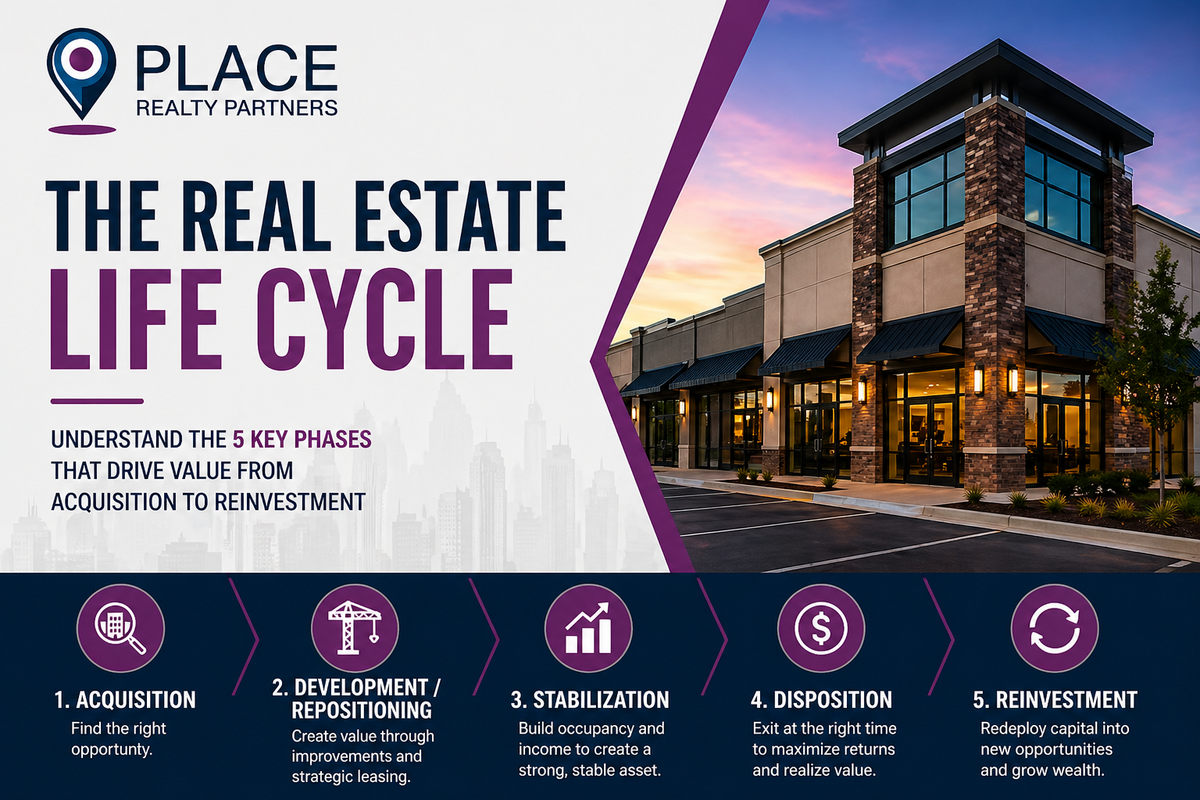
The real estate life cycle explains how properties move from acquisition to reinvestment. Understanding each phase helps investors in Houston maximize returns, reduce risk, and build long-term wealth.
Most people think real estate investing starts and ends with buying a property.
In reality, the most successful investors follow a repeatable process known as the real estate life cycle.
Each phase plays a critical role in determining how much value is created and how much profit is ultimately realized.
Whether you are investing in retail shopping centers or industrial properties in Northwest Houston, understanding this cycle can completely change how you approach deals.
1. Acquisition: Finding the Right Opportunity
Every deal begins with acquisition. This is where investors identify and purchase a property with the potential to create value.
In markets like Tomball, Spring, Cypress, and The Woodlands, strong acquisitions often come from:
- Underperforming retail centers with vacancy
- Industrial buildings with below-market rents
- Properties in growing submarkets with long-term upside
The key is not just buying a property. The key is buying the right property at the right basis.
Most of the profit in real estate is made at the time of purchase.
2. Development or Repositioning: Creating Value
After acquisition, the next step is to improve the asset.
This phase is where value is actively created through:
- Renovations and property upgrades
- Leasing vacant space
- Replacing weak tenants with stronger operators
- Improving overall tenant mix
For example, an older shopping center in Cypress can be repositioned by adding service-based tenants that drive consistent traffic.
An industrial property in Spring may benefit from upgrades that make it more functional for logistics or distribution users.
This phase requires strategy, execution, and a clear understanding of the market.
3. Stabilization: Building Consistent Income
Once improvements are complete, the goal is to stabilize the property.
A stabilized asset typically has:
- High occupancy
- Reliable tenants
- Predictable income
At this stage, the property becomes more attractive to investors seeking steady returns.
In Houston, stabilized retail and industrial properties often trade at premium valuations because they offer lower risk and consistent cash flow.
This is where the property transitions from a project into a performing asset.
4. Disposition: Realizing the Returns
Disposition is the phase where investors capture the value they have created.
This can be done by:
- Selling the property at a higher valuation
- Refinancing to access built-up equity
- Holding the asset for long-term income
Timing plays a major role in this phase. Selling into strong market conditions can significantly increase returns.
The goal is to exit the investment in a way that maximizes profit while aligning with your overall strategy.
5. Reinvestment: Scaling and Building Wealth
Reinvestment is where long-term wealth is built.
Instead of stopping after one successful deal, experienced investors take the profits and redeploy them into new opportunities.
This creates a cycle where capital continues to grow over time.
Reinvestment strategies may include:
- Acquiring larger or higher-quality assets
- Diversifying into different property types
- Expanding into stronger or emerging submarkets
In a market like Northwest Houston, reinvestment allows investors to scale from smaller properties into larger retail centers or industrial portfolios.
This is how portfolios grow and wealth compounds.
Why Understanding the Life Cycle Matters
Many investors focus only on acquisition and overlook the importance of the full cycle.
The reality is that each phase is connected. Decisions made early in the process directly impact the outcome at the end.
By understanding the full life cycle, you can:
- Make smarter acquisition decisions
- Create value more effectively
- Reduce risk during ownership
- Plan your exit with intention
- Build a repeatable investment strategy
Real-World Example in Northwest Houston
A common scenario might look like this:
An investor acquires a partially vacant retail center in Tomball at a favorable price.
They renovate the property, lease the remaining space, and improve the tenant mix.
Once stabilized, the property generates consistent income and becomes more attractive to buyers.
The investor then sells at a higher valuation and reinvests the proceeds into a larger asset in Cypress or The Woodlands.
This process repeats and builds momentum over time.
Final Thoughts
Real estate investing is not just about buying property. It is about understanding where a property sits within its life cycle and making decisions accordingly.
Each phase presents an opportunity to create value, manage risk, and increase returns.
The investors who succeed long term are the ones who think beyond a single transaction and focus on the full cycle.
Next Steps
If you are looking to invest in retail or industrial real estate in Northwest Houston, having a clear strategy for each phase of the life cycle is critical.
We help clients identify opportunities, create value, and execute successful investment strategies across Tomball, Spring, Cypress, and surrounding areas.
Reach out to discuss current opportunities and how to position your next deal for long-term success.