Hockley has no city hall and Harris County has no zoning, but industrial projects still face real rules. Here is how county permits generally work for warehouses, flex, and yards.
Hockley is where northwest Harris County starts to feel like open country. Grain farms and cattle ranches still surround the community, a rail line runs through it, and US 290 and State Highway 6 carry trucks between Houston and central Texas. That mix of rail, highway, and open land is why we see steady interest here from warehouse, flex, contractor yard, and truck parking users. The first surprise for many of them is how permits work in a place with no city hall.
This guide covers commercial industrial property only. It explains how county rules generally work, not what they require on any one parcel.
Start with the county line
Hockley is an unincorporated community, so there is no Hockley city government issuing permits. It sits in northwestern Harris County, close to the Waller County line, and a Hockley mailing address may not tell you which county a tract is actually in. That matters because the two counties run separate permit offices with their own applications and reviews. Check the appraisal district record and the title commitment, and confirm with the county before you pay for plans. If the land turns out to be on the Waller County side, our Waller industrial permit guide covers how that side generally works.
No zoning does not mean no rules
Harris County says it does not have zoning in its unincorporated areas. Nobody at the county will tell you a warehouse belongs on one tract and not the next. What the county does run are rules on floodplain management, septic systems, driveways, and signs, plus the Harris County Fire Code for commercial buildings. In plain terms, the county cares less about what you build and more about how: where the water goes, how trucks reach the road, and whether the building is safe to occupy.
The other big layer is private. Recorded deed restrictions can limit uses, building materials, setbacks, and outdoor storage, and they sit apart from county permits. Read the title work closely, especially on land that was once part of a larger ranch or a planned business park.
The site permit covers the dirt
For new industrial work in unincorporated Harris County, permits generally run through the Harris County Engineering Department, which takes applications online through its E-Permits system. Think of the commercial site development permit as the permit for everything outside the walls: grading, paving, driveways, culverts, and stormwater quality features. Depending on the scope, the plans may also go to the county reviewers who handle right of way, stormwater quality, and traffic.
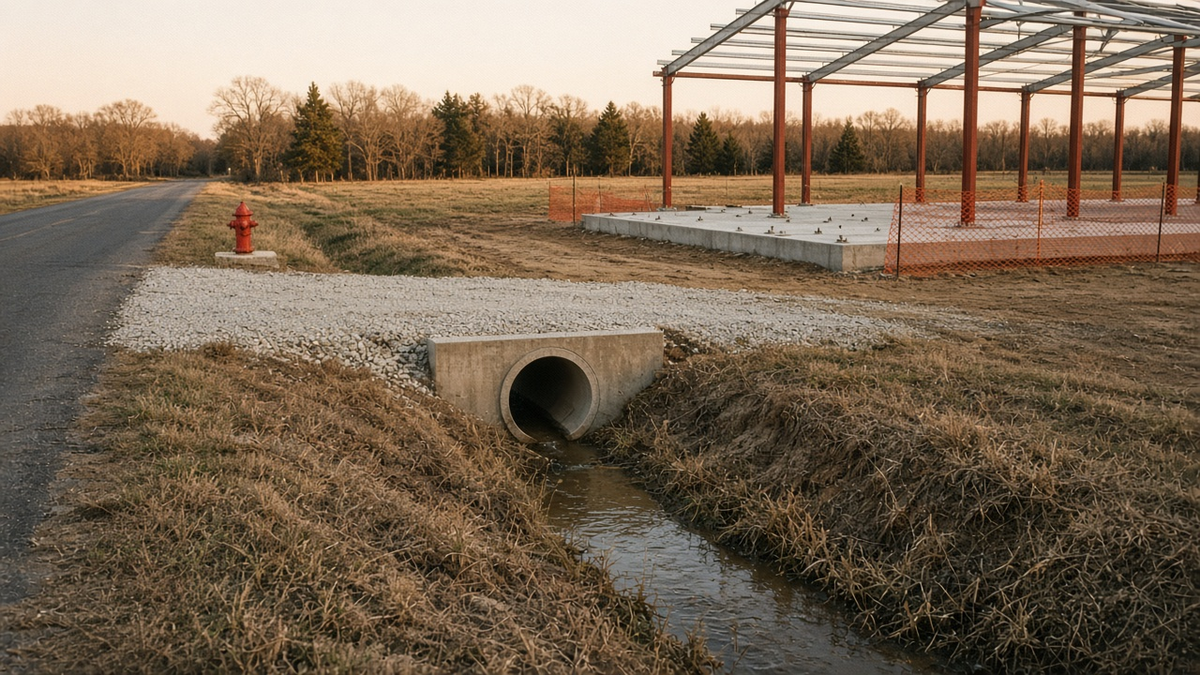
For a truck heavy user, this permit often shapes the deal more than the building does. A paved truck court, a wider driveway, a culvert across the roadside ditch, and detention for the added pavement all show up here. If the tract fronts a state highway such as US 290 or State Highway 6, a new or changed driveway generally needs a separate access permit from the Texas Department of Transportation, and any drainage effect on the highway gets worked out with the state first.
Larger sites may also need a construction stormwater permit from the Texas Commission on Environmental Quality, which your engineer or contractor usually handles.
When the floodplain is involved
If any part of a tract sits in a mapped flood hazard area, the rules get stricter. The county requires a floodplain development permit for work in the floodplain, and that covers grading, fill, and paving, not just buildings. Structures there also need elevation certificates from a licensed surveyor, engineer, or architect. Check the county flood maps early, because fill and detention can eat into usable land and budget.
The building and the fire code
The building itself is reviewed under the Harris County Fire Code through a commercial building permit, with fire inspections coordinated with the Harris County Fire Marshal's Office. For a warehouse or flex building, fire protection is often the long pole. If the building needs sprinklers, the county reviews and approves the underground fire line before it reviews the sprinkler system above ground. Storage height, the kinds of goods inside, and any flammable materials can all change what the fire code asks for.
On rural tracts, utilities belong in the same conversation. Where there is no public sewer, a commercial site generally needs a county septic permit, and a commercial water well has its own county permit.
At the end, the county issues a certificate of compliance before occupancy, rather than the certificate of occupancy a city would issue. Lenders, buyers, and tenants will ask to see it.
Yards, outdoor storage, and truck parking
Plenty of industrial users out here need more land than building. A contractor might want a small shop with a big yard. A trucking company might want parking and a maintenance bay. Without zoning, the county is not approving the use itself, but the yard is still site work. Grading, new paving, and a new driveway generally fall under the site development permit, and the floodplain rules apply if the yard sits in a flood hazard area. Some yard uses also have their own county permits and inspections, including junk, auto wrecking, and salvage yards and metal recycling.
Buying or leasing what is already there
If you are looking at an older building, the paper trail matters. Harris County's own guidance says commercial buildings permitted before the county applied its fire code to commercial construction were not subject to any building code. Do not assume an older building meets today's rules. If you change how the building is used, such as moving from simple storage to fabrication, or take on a major renovation, the county can treat the work as a substantial improvement that brings new review.
Before you sign, ask the seller or landlord for the certificate of compliance, approved plans, fire protection approvals, site and driveway permits, and the recorded plat. If the deal depends on splitting off part of a tract, platting comes first, which we walked through in our Hockley plat review guide. Owner users weighing a smaller building can also read our guide to buying a small flex building.
Our view
Hockley gives industrial users room that is hard to find closer in, and the lack of zoning can make the use question simpler than it is inside a city. The work shifts to the site, the water, the driveway, and the fire code. We suggest confirming the county, the flood map, and the deed restrictions before you write an offer, and keeping a feasibility period long enough for your engineer to talk with the county.
This article is general information, not legal advice. Permit requirements, fire code review, floodplain rules, driveway access, and deed restrictions vary by property and by county and can change, so confirm them with Harris County, Waller County where it applies, the relevant state agencies, and a qualified Texas real estate attorney before you commit.
Looking at industrial land or a building around Hockley? Talk with our team and we will help you line up the right questions for the county.